Reference record · strategic system
2 sources ↗Unit Veterancy System
A progression system through which surviving units grow in power and may unlock new abilities.
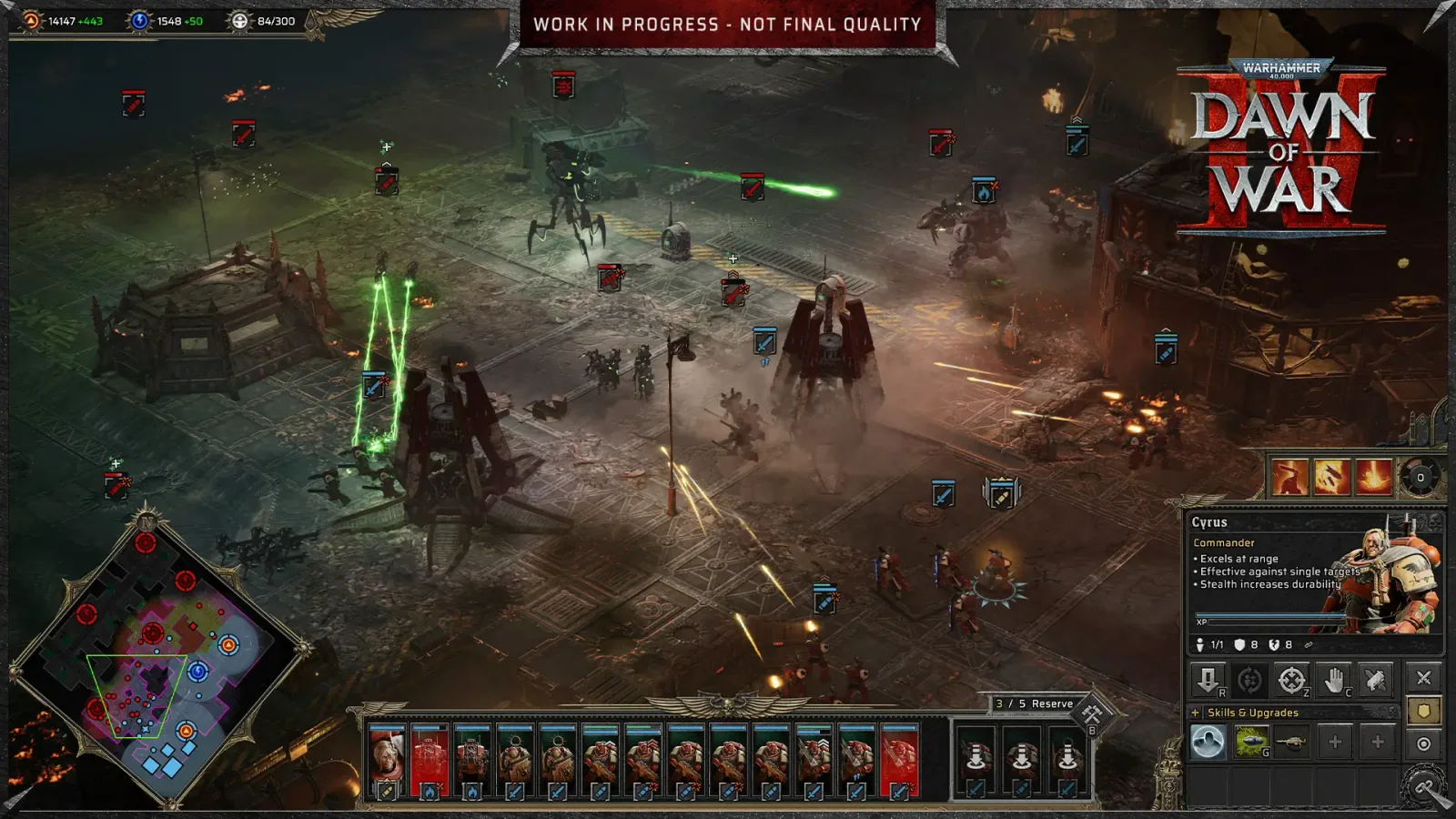 ⤢ View full image
 Credit and source
Aucune INTERDICTION d'usage publiée. Constaté le 2026-08-17 puis le 2026-08-24, à deux adresses : https://www.deepsilver.com/games/dawn-of-war-iv/media et https://www.deepsilver.com/fr/about/imprint. Les deux ne portent qu'un avis de copyright — « © 2026 PLAION GmbH. All rights reserved. […] Developed by KING Art GmbH » — et aucune clause restreignant la reproduction, la distribution ou l'usage éditorial. Droits de l'univers : Games Workshop Limited 2026. Usage éditorial, crédité, retiré à la première demande de l’ayant droit (D-056, D-057, D-069).
Image source ↗Your reading, at a glance
Sourced facts
2 sourced factsRecord profile
- Progression
- Surviving units gain power; benefits vary by faction
- Possible benefit
- Stat improvements or new unit abilities
The role, in context
Unit Veterancy System is the progression framework through which surviving units grow in power. The main game page ties advancement to units that survive and continue performing in battle, while the multiplayer AMA says the resulting benefits differ across factions and can range from statistical improvements to new abilities. That establishes persistence and variable rewards without defining every path. The sources do not publish experience thresholds, level limits, gain rates, eligible actions, death penalties, faction tables, ability lists or whether veterancy carries between ordinary matches.
What is documented over time
Veterancy is presented as part of Dawn of War IV’s emphasis on preserving forces rather than treating every squad as disposable. The multiplayer explanation places it beside cover, retreat and on-field reinforcement, all described as tools for keeping experienced units alive in different circumstances. Variation by faction is deliberate: some units receive statistical growth, while others may unlock abilities. This is current systems design, not a balance chronology. No earlier threshold, revised benefit, reset rule, patch sequence, version comparison or inherited progression model is documented.
How it is presented in play
Directional cover and garrisonable structures reduce ranged damage; the latter protect from all directions. Orks can build cover, Adeptus Mechanicus can build a garrisonable structure, and Necrons do not use cover. Flamers and grenades can negate it; melee forces units out. Retreat disengages melee or moves units to the closest production structure with reduced damage, but temporarily removes control. The order can be cancelled when its icon turns yellow. These tools and on-field reinforcement help preserve units and XP. Cover is an optimization, not a decisive advantage; exact damage reductions and timings remain unpublished.
What you can — and cannot — conclude
The common misunderstanding is to treat veterancy as one identical statistical ladder for every faction. The AMA explicitly says its benefits vary, from stat improvements to newly unlocked unit abilities, while the main page only confirms that surviving units grow in power. Because this is a progression system, the supported correction concerns preservation and variation rather than a direct combat counter. The sources do not state how opponents remove earned levels, which units should be prioritised or whether retreat cancels progress. Any denial sequence, target list or breakpoint would exceed the evidence.