Reference record · strategic system
2 sources ↗Reserves
A deployment mechanic used by Space Marines and Necrons to move held units toward an active battlefront.
 ⤢ View full image
 Credit and source
Aucune INTERDICTION d'usage publiée. Constaté le 2026-08-17 puis le 2026-08-24, à deux adresses : https://www.deepsilver.com/games/dawn-of-war-iv/media et https://www.deepsilver.com/fr/about/imprint. Les deux ne portent qu'un avis de copyright — « © 2026 PLAION GmbH. All rights reserved. […] Developed by KING Art GmbH » — et aucune clause restreignant la reproduction, la distribution ou l'usage éditorial. Droits de l'univers : Games Workshop Limited 2026. Usage éditorial, crédité, retiré à la première demande de l’ayant droit (D-056, D-057, D-069).
Image source ↗Your reading, at a glance
Sourced facts
2 sourced factsRecord profile
- Space Marine use
- Works with the Thunderhawk Relay for rapid troop movement
- Necron use
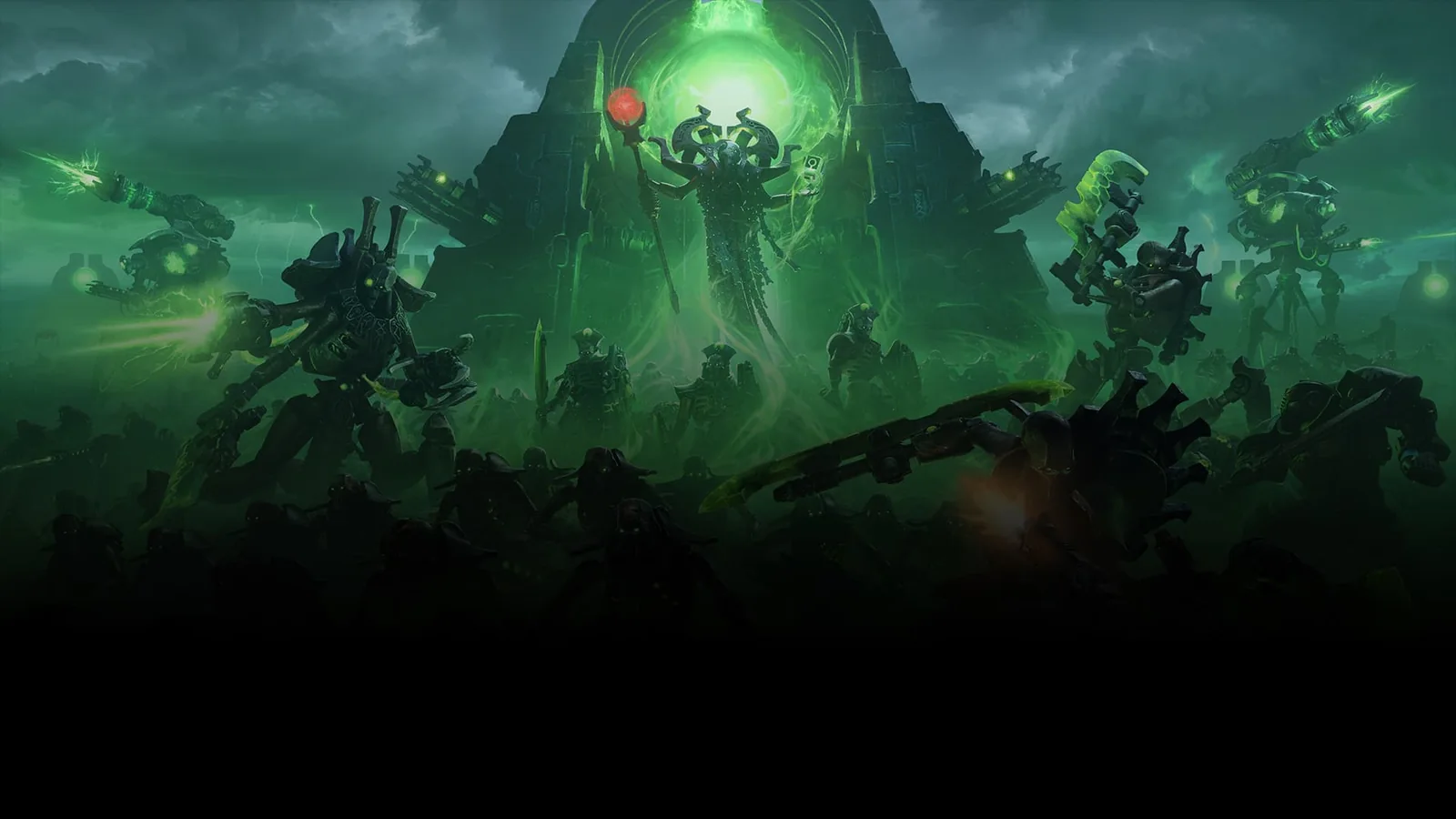
- The Monolith’s Eternity Gate deploys units reserved at the Tomb Citadel
The role, in context
Reserves is a deployment concept documented for both Space Marines and Necrons, but through different faction systems. Space Marines combine held forces with the Thunderhawk Relay to move troops rapidly toward a needed area. Necron units placed in reserve at the Tomb Citadel can emerge from a Monolith’s Eternity Gate at the active battlefront. These examples establish redeployment, not one universal implementation. The sources do not publish capacity, entry rules, delay, eligible units, visibility requirements, cancellation, cost, vulnerability or whether the two factions share any underlying limits.
What is documented over time
Reserves supports the design problem of moving valuable or slow forces across a changing battlefield. For Space Marines, it complements fortifications and limited elite presence; for Necrons, it links the Tomb Citadel to a Monolith so slow units can reach a distant fight. The qualified pages present these as current faction tools, not as a shared mechanic inherited unchanged from earlier games. No previous implementation, revised capacity, altered delay, renamed command, balance adjustment, patch history or version comparison is documented for either faction’s use of Reserves.
How it is presented in play
The documented use depends on faction context. Space Marines use Reserves with the Thunderhawk Relay for rapid troop movement, while Necrons hold units at the Tomb Citadel for deployment through a Monolith’s Eternity Gate. Both examples solve distance, but the pages do not say that their inputs, limits or destinations are identical. No preferred unit, capacity, travel time, queue, retrieval rule or optimal timing is published. Guidance should explain each documented route separately rather than invent a common rotation or treating every reserve exit as interchangeable.
What you can — and cannot — conclude
The common mistake is to treat Reserves as one identical system across factions or to assume that removing an exit point erases troops already deployed. The official pages document two distinct routes: Space Marines pair Reserves with a Thunderhawk Relay, and Necrons connect the Tomb Citadel to a Monolith’s Eternity Gate. They do not publish interception, cancellation, stranded-unit or destruction rules for either route. A careful response can identify the relevant network, but cannot prescribe a damage type, target order, denial timing or guaranteed way to stop deployment.