Reference record · mechanic
1 sources ↗Separate Campaign and Multiplayer Balance
A stated policy of balancing the campaign and the multiplayer separately, so the same unit can differ in strength between them.
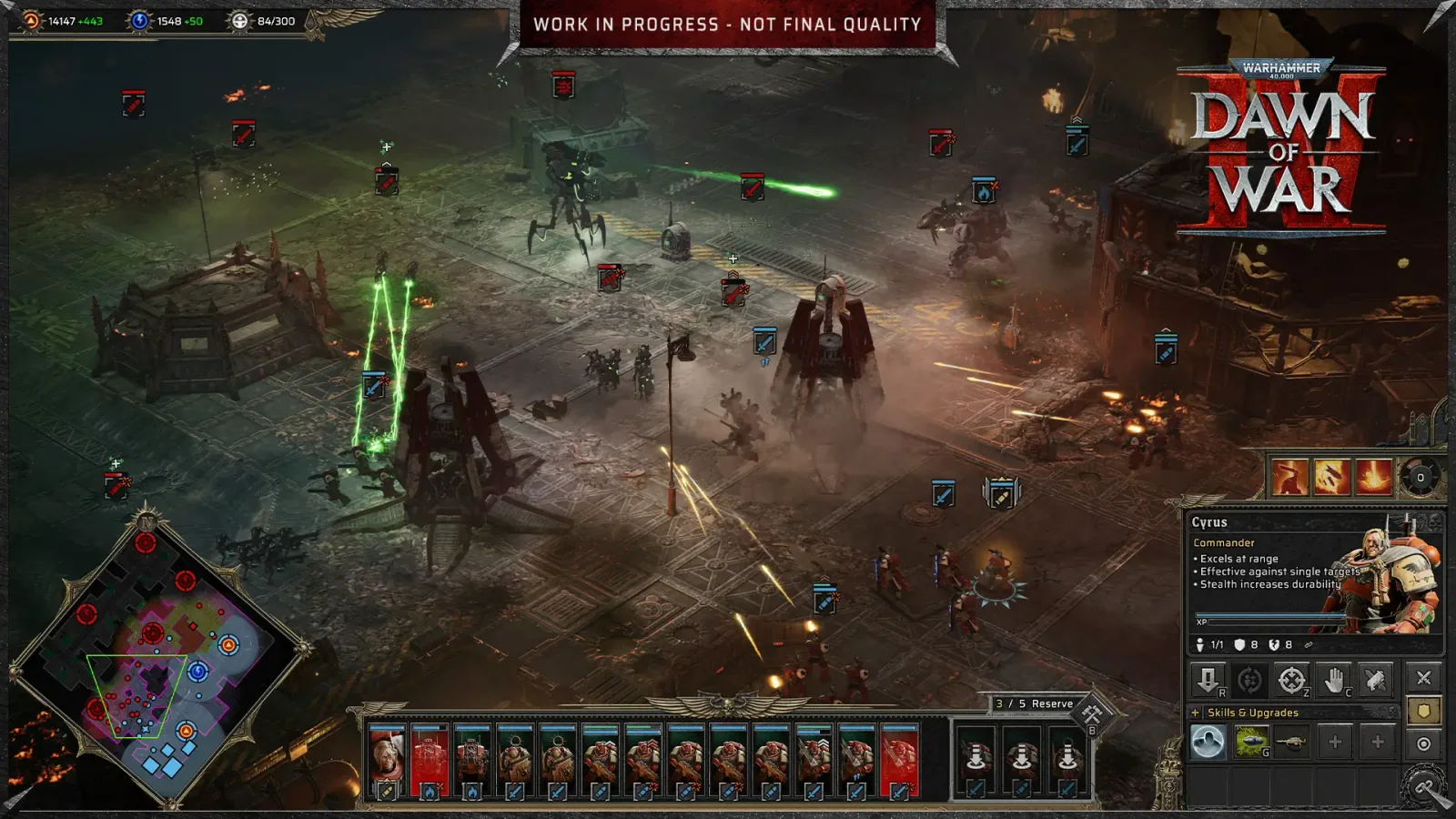 ⤢ View full image
 Credit and source
Aucune INTERDICTION d'usage publiée. Constaté le 2026-08-17 puis le 2026-08-24, à deux adresses : https://www.deepsilver.com/games/dawn-of-war-iv/media et https://www.deepsilver.com/fr/about/imprint. Les deux ne portent qu'un avis de copyright — « © 2026 PLAION GmbH. All rights reserved. […] Developed by KING Art GmbH » — et aucune clause restreignant la reproduction, la distribution ou l'usage éditorial. Droits de l'univers : Games Workshop Limited 2026. Usage éditorial, crédité, retiré à la première demande de l’ayant droit (D-056, D-057, D-069).
Image source ↗Your reading, at a glance
Sourced facts
3 sourced factsRecord profile
- Documented approach
- Campaign and multiplayer are treated as two entirely separate things and balanced accordingly
- Documented consequence
- A unit can be left deliberately powerful in the campaign and toned down in multiplayer
- Stated priority
- Storytelling is not compromised to guarantee multiplayer fairness
The role, in context
Separate Campaign and Multiplayer Balance is a stated development policy rather than a system the player operates. The studio describes the campaign and the multiplayer as two entirely separate things that are balanced accordingly, so the same unit can carry a different strength in each. Its documented purpose is to keep the story campaign from paying for competitive fairness. The sources publish no figures, no list of affected units, no multiplier and no dated adjustment. It belongs here because its effect is described and visible in play, but it should be read as a design commitment rather than a rule a player can act on.
What is documented over time
The policy is presented as an early decision, not a later correction. The studio states that it decided very early on that a balanced multiplayer experience would be essential, while refusing to let the story campaign suffer for it. No previous approach is described, no build is named in which the two modes shared a single balance pass, and no example of a unit that was actually retuned is given. What exists is one dated statement of intent made during development. The sources publish no sequence of changes behind it, so this section records a position rather than a revision history.
How it is presented in play
The practical consequence for a reader is that campaign strength is not evidence of multiplayer strength, and the reverse holds too. The studio says that if a unit should be exceptionally powerful in the campaign because it serves the story, it will be left that way even when the same unit is toned down for multiplayer. Nothing published names which units this applies to, in which direction, or by how much they differ. Carrying an impression formed in one mode into the other is therefore unsupported by anything the sources state, and no build or loadout advice can be derived from this policy.
What you can — and cannot — conclude
The mistake this policy invites is transferring a conclusion from one mode to the other. A unit that dominated a campaign mission is nowhere documented as dominant in multiplayer, and a multiplayer answer is nowhere documented as an answer in the campaign. On the competitive side the stated aim is to avoid imbalanced units and cheese tactics, but no cheese tactic, no problem unit and no corrective measure is named anywhere in the published material. There is nothing here to counter and no matchup advice to draw from it; the record stops at what the studio said it intends to do.