Reference record · customisation system
1 sources ↗Painter tool
An in-game feature for customising the appearance of the player’s armies and units.
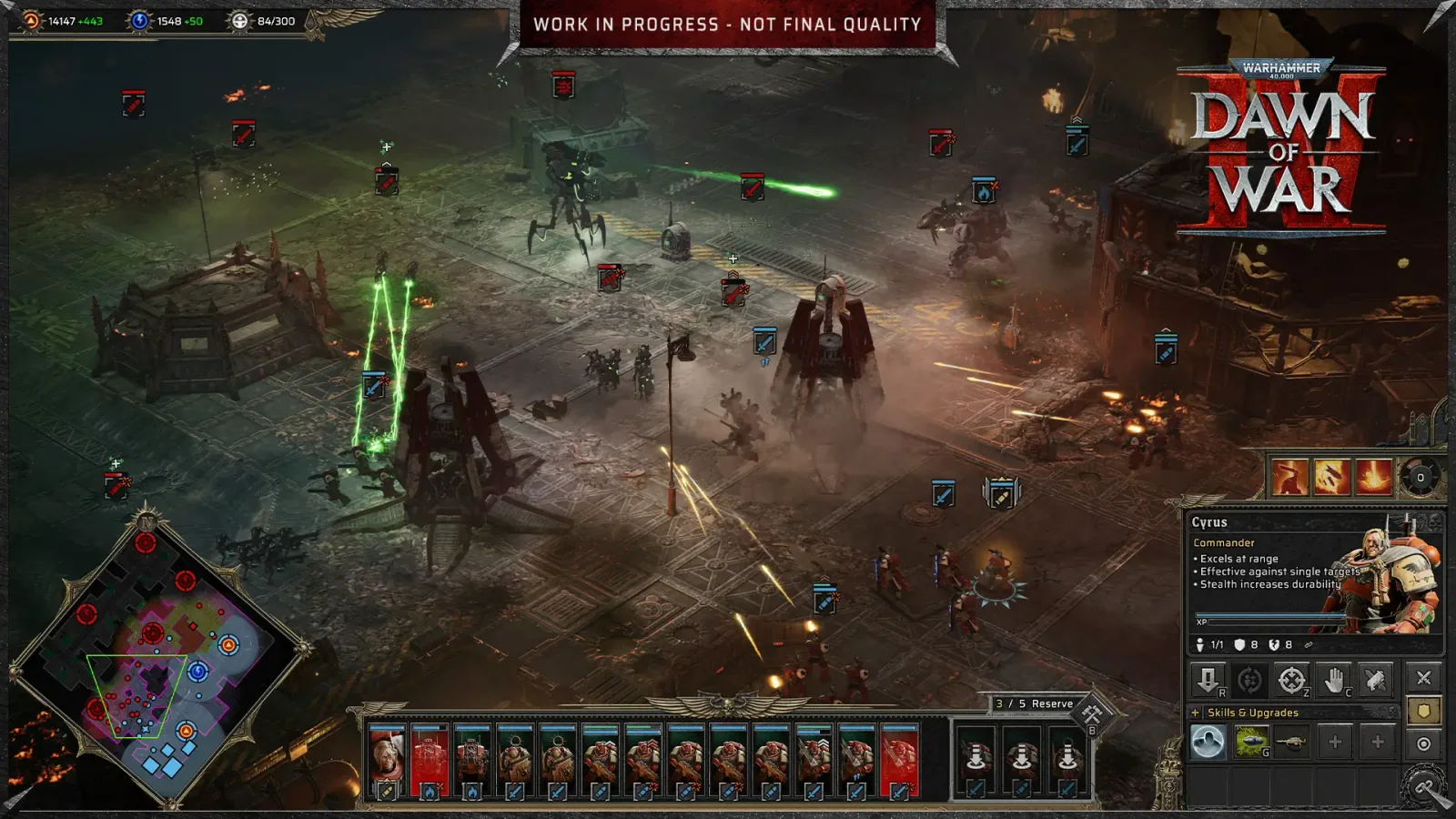 ⤢ View full image
 Credit and source
Aucune INTERDICTION d'usage publiée. Constaté le 2026-08-17 puis le 2026-08-24, à deux adresses : https://www.deepsilver.com/games/dawn-of-war-iv/media et https://www.deepsilver.com/fr/about/imprint. Les deux ne portent qu'un avis de copyright — « © 2026 PLAION GmbH. All rights reserved. […] Developed by KING Art GmbH » — et aucune clause restreignant la reproduction, la distribution ou l'usage éditorial. Droits de l'univers : Games Workshop Limited 2026. Usage éditorial, crédité, retiré à la première demande de l’ayant droit (D-056, D-057, D-069).
Image source ↗Your reading, at a glance
Sourced facts
1 sourced factRecord profile
- Documented function
- Customises the appearance of in-game armies
The role, in context
Painter tool is an in-game customisation system for adding personalised visual finishing touches to units under the player’s command. The project vision presents it as a way to make an army and its battlefield appearance feel individual, alongside the game’s campaigns and repeatable modes. Its documented purpose is appearance, not combat performance. The source does not publish colour channels, pattern libraries, emblem support, save slots, sharing, import features, faction restrictions, unlock conditions or any statistical effect. Its supported identity remains visual customisation rather than broader army management.
What is documented over time
The Painter tool is announced as part of the team’s aim to support players’ broader enthusiasm for Warhammer armies, ensuring that force customisation remains part of Dawn of War IV. The project vision says the game will include the feature and describes its role in personalising commanded units. That is product and design context rather than an evolution record. The qualified page does not compare the tool with an earlier series painter, document a prototype, list removed options, describe a redesign, provide a patch sequence or establish that any previous customisation feature returns unchanged.
How it is presented in play
The only supported use is visual personalisation of the units under a player’s command. That makes the Painter tool relevant when shaping an army’s appearance, but the source does not describe how edits are applied, stored, copied or shared. It also does not say whether schemes can be changed during a campaign, whether every unit exposes the same options or whether customisation affects identification in multiplayer. High-level guidance should frame the feature as appearance control and stop before inventing a workflow, unlock route, recommended palette or gameplay benefit.
What you can — and cannot — conclude
The common mistake is to treat a custom visual scheme as evidence of an upgrade, faction bonus or hidden combat effect. The qualified source describes the Painter tool only as a way to personalise the appearance of commanded units. It does not connect colour, pattern or any other cosmetic choice to statistics, abilities, targeting or progression. Because this is a customisation system, there is no supported combat counter to provide. The useful answer is to separate appearance from documented rules; any tactical advantage, readability setting or competitive restriction would be invented.