Reference record · strategic system
2 sources ↗Combat Director
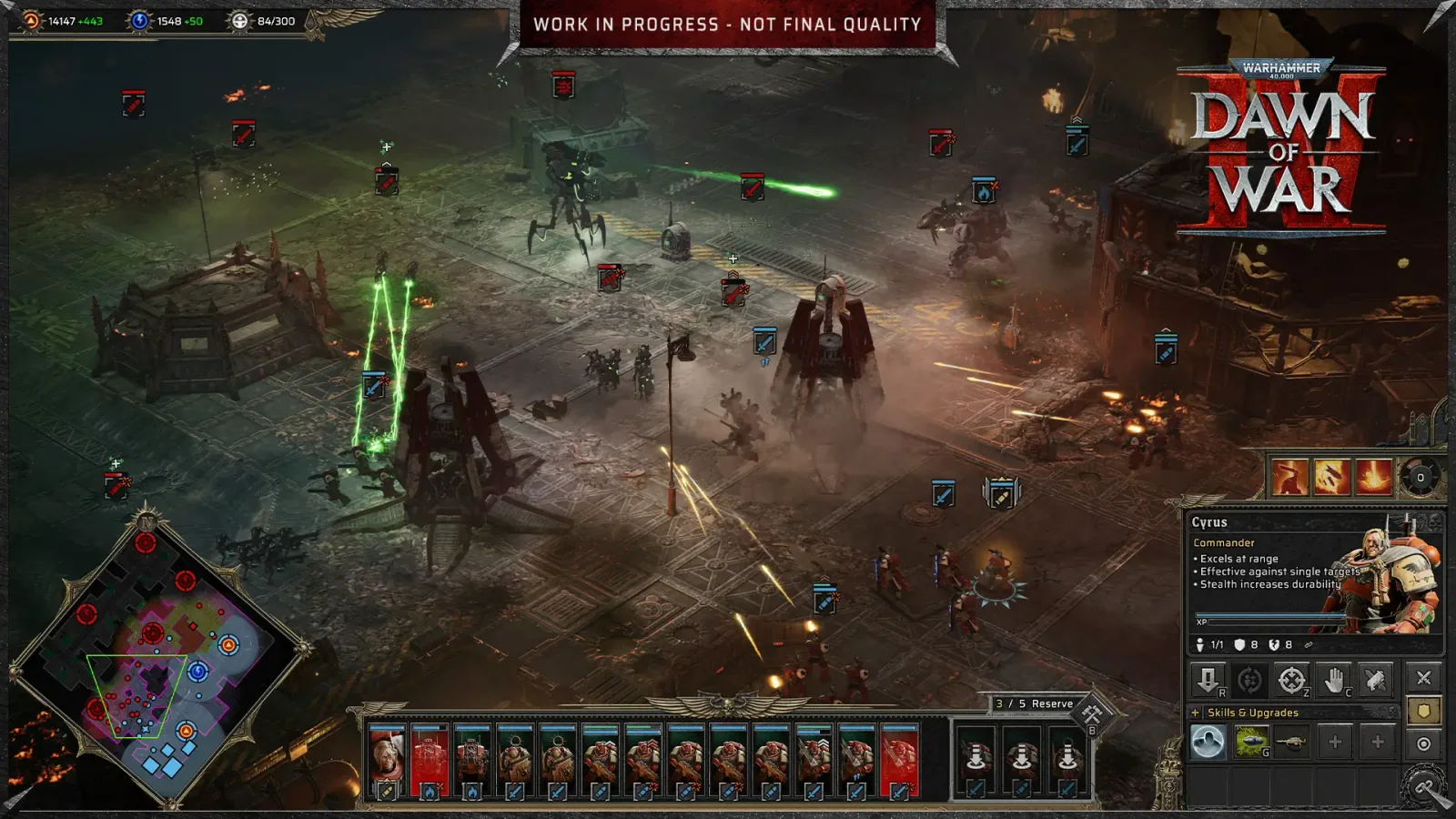
An animation system that continually assesses engagements and assembles matching combat animation sequences.
 ⤢ View full image
 Credit and source
Aucune INTERDICTION d'usage publiée. Constaté le 2026-08-17 puis le 2026-08-24, à deux adresses : https://www.deepsilver.com/games/dawn-of-war-iv/media et https://www.deepsilver.com/fr/about/imprint. Les deux ne portent qu'un avis de copyright — « © 2026 PLAION GmbH. All rights reserved. […] Developed by KING Art GmbH » — et aucune clause restreignant la reproduction, la distribution ou l'usage éditorial. Droits de l'univers : Games Workshop Limited 2026. Usage éditorial, crédité, retiré à la première demande de l’ayant droit (D-056, D-057, D-069).
Image source ↗Your reading, at a glance
Sourced facts
4 sourced factsRecord profile
- Documented function
- Matches animation snippets to the participants and situation in each engagement
- Related feature
- Sync kills
- Documented scale
- Millions of potential animation combinations across combat scenarios
- Engine comparison stated by the studio
- Described as beyond what the studio’s previous RTS, Iron Harvest, could have handled in 2020
The role, in context
Combat Director is an animation system that continually evaluates each engagement and assembles matching animation snippets for the participants and situation. It expands the series’ sync-kill idea beyond selected finishing moves so that personalised combat animation can appear throughout a battle. Its documented purpose is visual detail, brutality and immersion, not a player-controlled tactical resource. The sources publish no activation input, cost, cooldown, damage modifier, targeting priority or victory effect. It should be understood as presentation technology rather than a combat ability.
What is documented over time
The system grows from the earlier Dawn of War sync-kill approach, where paired characters performed choreographed final blows. For Dawn of War IV, the team asked why synchronisation should be limited to the last attacks and developed a prototype that could account for participants, relative types and situations throughout combat. That prototype became Combat Director. This is a documented design evolution in animation scope, not gameplay balancing. The articles give no patch sequence, version number, removed mechanic or evidence that the system changes unit statistics or combat resolution.
How it is presented in play
Combat Director works behind the scenes rather than through a player order. It observes who is present, which side each participant belongs to and how damage should be represented, then stitches suitable animation pieces into the engagement. For players, the useful distinction is interpretive: an elaborate sequence is part of the visual system, not proof of a special ability, hidden upgrade or manually triggered execution. The sources do not say that watching, cancelling or seeking these animations improves an outcome. No tactical rotation, resource plan or competitive use is therefore supported.
What you can — and cannot — conclude
The common mistake is to treat Combat Director as a battlefield power that can be activated, denied or countered. Its published function is to select and combine animations that fit an engagement; the sources do not assign it damage, control, targeting or economy effects. Sync kills and other sequences may look decisive, but appearance alone does not establish a separate gameplay modifier. The accurate response is to separate visual presentation from documented rules. No enemy response, interruption method, timing window or setting that grants an advantage is published, so none belongs in this section.