Reference record · strategic system
1 sources ↗On-field reinforcement
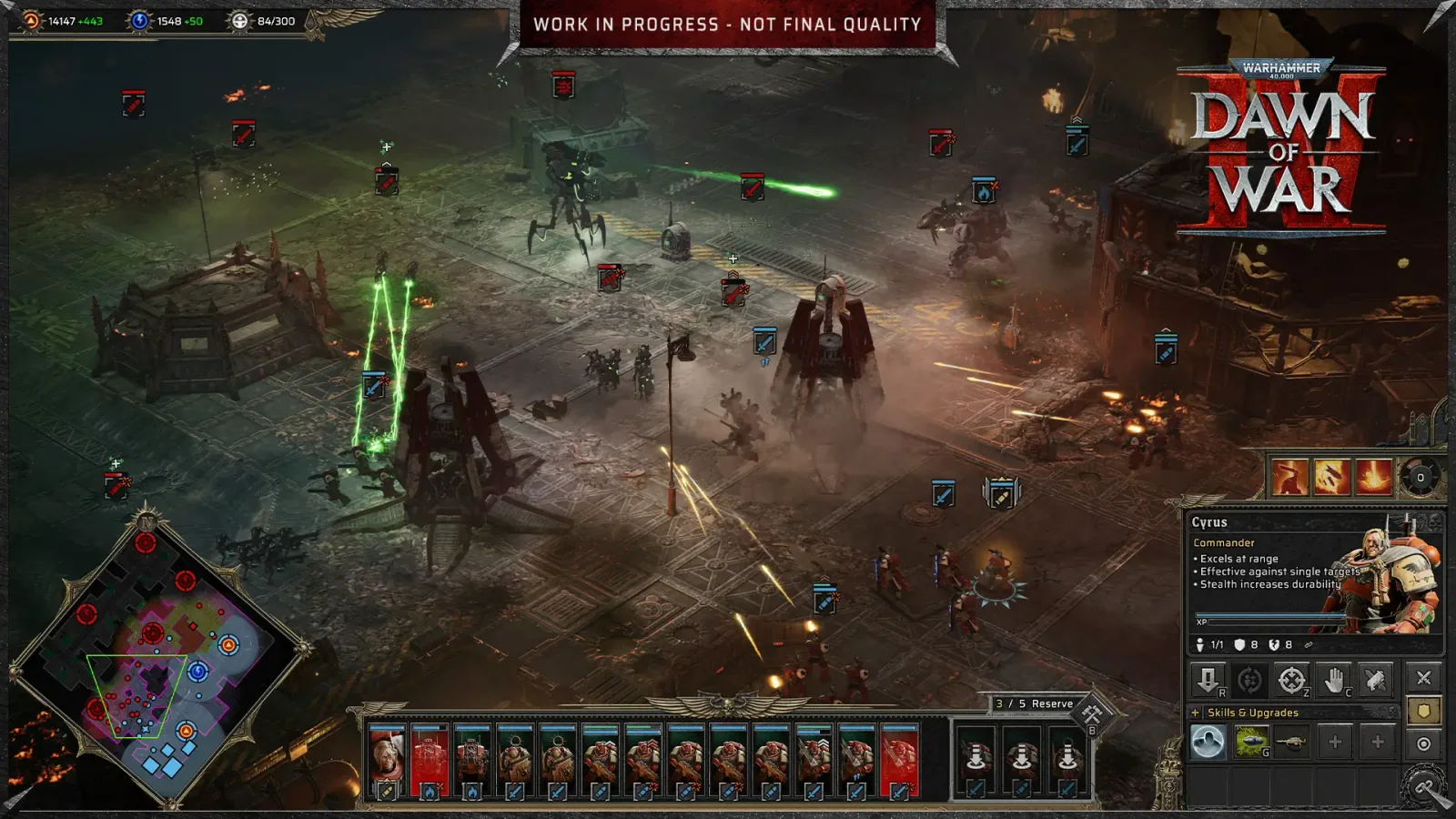
A force-preservation mechanic that reinforces units in the field while consuming the player’s economy.
 ⤢ View full image
 Credit and source
Aucune INTERDICTION d'usage publiée. Constaté le 2026-08-17 puis le 2026-08-24, à deux adresses : https://www.deepsilver.com/games/dawn-of-war-iv/media et https://www.deepsilver.com/fr/about/imprint. Les deux ne portent qu'un avis de copyright — « © 2026 PLAION GmbH. All rights reserved. […] Developed by KING Art GmbH » — et aucune clause restreignant la reproduction, la distribution ou l'usage éditorial. Droits de l'univers : Games Workshop Limited 2026. Usage éditorial, crédité, retiré à la première demande de l’ayant droit (D-056, D-057, D-069).
Image source ↗Your reading, at a glance
Sourced facts
2 sourced factsRecord profile
- Documented benefit
- Keeps units in fighting condition and makes auto-reinforced units harder to kill
- Documented cost
- Continuous resource drain when many units auto-reinforce
The role, in context
On-field reinforcement is a force-preservation system that lets players commit resources to extend a unit’s longevity away from production structures. The multiplayer AMA describes it as a way to keep forces in fighting condition, influence an engagement or buy time while reinforcing a position. Units using automatic reinforcement become harder to finish, but maintaining the setting across many units drains the economy rapidly. The source does not publish per-model costs, reinforcement time, eligible unit lists, range rules, cancellation behaviour or the exact difference of the Necron variant.
What is documented over time
The system is discussed as one of several tools for preserving experienced units in multiplayer, alongside cover and retreat. Its design purpose is to bring economy directly into combat: a player can spend resources to sustain a force, but broad automatic reinforcement may win the immediate engagement while damaging the wider war effort. The AMA also notes that its effect in combat is generally limited, with a Necron exception left undescribed. This is current design explanation, not revision history. No earlier rule, changed cost, balance pass, patch sequence or version comparison is provided.
How it is presented in play
The supported decision is a trade between battlefield staying power and economic health. Reinforcement can extend unit life, help tip a contested fight or buy time at a position, while automatic reinforcement makes units harder to kill. The same source warns that applying it widely consumes resources very quickly, so activation is not free sustain. No numerical breakpoint, ideal unit, duration, faction ranking or exact engagement threshold is published. High-level use should frame the commitment as a deliberate economy-to-combat choice rather than prescribe a universal toggle pattern.
What you can — and cannot — conclude
The common mistake is to assume that on-field reinforcement creates durability without a strategic price. The multiplayer AMA states the opposite: many units on automatic reinforcement can drain resources rapidly, even when the immediate battle goes well. Because this is a strategic system rather than an offensive entity, the evidence supports correcting that timing and economy error, not inventing a combat counter. The source names no interruption method, anti-reinforcement unit, vulnerable animation or way for an opponent to cancel the process, so those claims remain unsupported.