Reference record · strategic system
1 sources ↗Destruction System
A dedicated system under which constructed buildings collapse when sufficiently damaged and scenery can be reduced to rubble by stray fire.
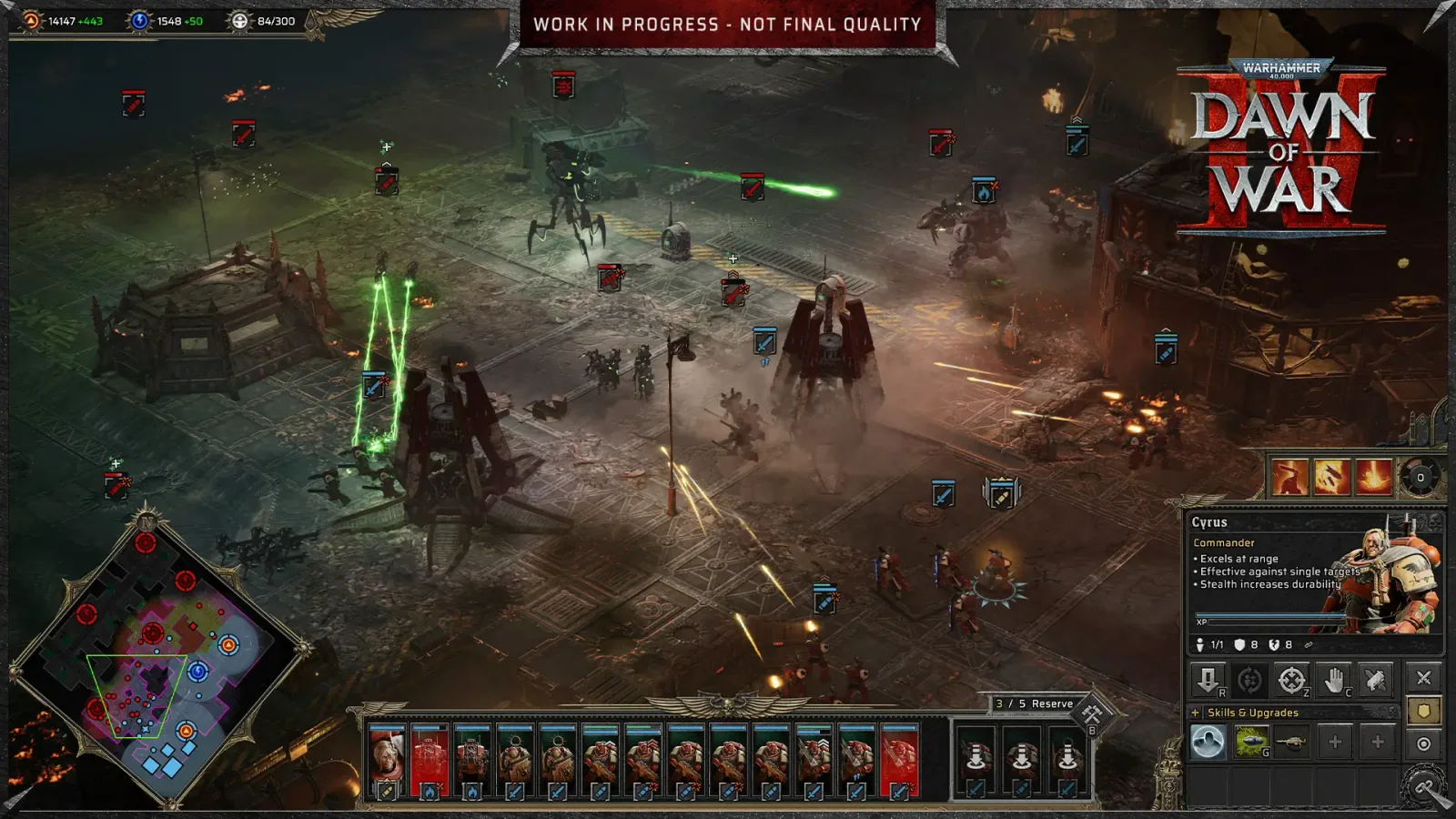 ⤢ View full image
 Credit and source
Aucune INTERDICTION d'usage publiée. Constaté le 2026-08-17 puis le 2026-08-24, à deux adresses : https://www.deepsilver.com/games/dawn-of-war-iv/media et https://www.deepsilver.com/fr/about/imprint. Les deux ne portent qu'un avis de copyright — « © 2026 PLAION GmbH. All rights reserved. […] Developed by KING Art GmbH » — et aucune clause restreignant la reproduction, la distribution ou l'usage éditorial. Droits de l'univers : Games Workshop Limited 2026. Usage éditorial, crédité, retiré à la première demande de l’ayant droit (D-056, D-057, D-069).
Image source ↗Your reading, at a glance
Sourced facts
3 sourced factsRecord profile
- Documented function
- Buildings collapse once sufficiently damaged
- Documented scope
- Scenic elements such as structures and vehicle wrecks can be turned to rubble by errant fire
- Stated purpose
- Spectacle, and a battlefield that looks scarred by the fighting
The role, in context
The destruction system is described as a dedicated system built so that each battlefield comes apart convincingly. Its documented effects are that buildings the player constructs collapse once sufficiently damaged, and that scenic elements such as structures and vehicle wrecks can be reduced to rubble by fire that misses its target. Its stated purpose is spectacle, and a landscape that looks scarred by the fighting that happened on it. No damage threshold, rubble lifetime, movement effect or cover value is published, so it is documented as visual behaviour rather than a tactical resource.
What is documented over time
The system enters the record alongside the Back to War in-engine trailer, as one of the features the studio picked out from footage running in the game engine. The article presents it as built for Dawn of War IV, without comparing it to a destruction model in an earlier title and without describing a prototype stage that preceded it. No revision, version or change of scope is documented, and nothing published since revisits it. What exists is a single dated presentation of the system as it stood when the trailer was shown, which is what this section records.
How it is presented in play
For a reader, what is documented is behaviour to expect rather than a lever to pull. Buildings raised during a battle will fall once they have taken enough damage, and the scenery around them can itself be broken apart by fire that misses. The article illustrates the point with a Gorkanaut firing a barrage of rokkits and notes that not all of them will hit their mark. No source states that rubble blocks movement, grants cover, changes line of sight or alters any unit statistic, so no positioning or timing recommendation can be built on it here.
What you can — and cannot — conclude
The mistake is to read destruction as a tactic. Nothing published describes demolishing scenery to open a path, to deny cover or to shape an engagement, and no unit is named as being suited to doing it. The sources present the system as a consequence of fighting rather than an action taken on purpose. Until an official page documents a deliberate use, any claim that a player can destroy terrain for an advantage would be an inference, and this record does not make one. What is established is that the battlefield changes shape as it is fought over.