Reference record · production structure
2 sources ↗Resurrection Galleries
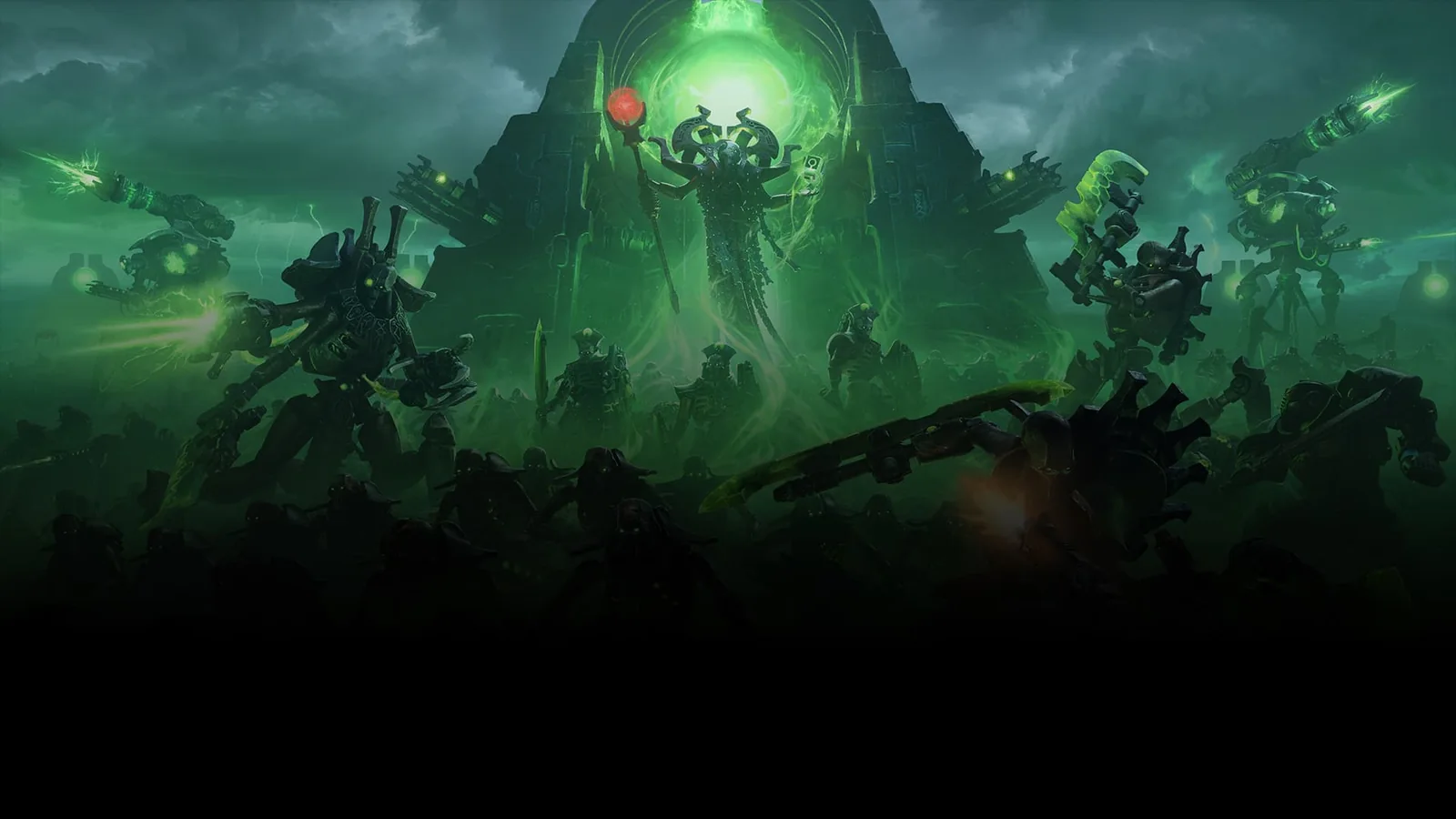
Necron structures that return a selected type of fallen unit without an additional unit cost.
 ⤢ View full image
 Credit and source
Aucune INTERDICTION d'usage publiée. Constaté le 2026-08-17 puis le 2026-08-24, à deux adresses : https://www.deepsilver.com/games/dawn-of-war-iv/media et https://www.deepsilver.com/fr/about/imprint. Les deux ne portent qu'un avis de copyright — « © 2026 PLAION GmbH. All rights reserved. […] Developed by KING Art GmbH » — et aucune clause restreignant la reproduction, la distribution ou l'usage éditorial. Droits de l'univers : Games Workshop Limited 2026. Usage éditorial, crédité, retiré à la première demande de l’ayant droit (D-056, D-057, D-069).
Image source ↗Your reading, at a glance
Sourced facts
2 sourced factsRecord profile
- Documented role
- Returns a selected preferred unit type after that type falls in battle
The role, in context
Resurrection Galleries are Necron production structures that return losses of a selected unit type. After constructing one, the player chooses a preferred type; when a unit of that type falls, the Gallery can bring it back without an additional unit cost. This function supports the faction’s wider identity of resilience and recovery, alongside the Power Matrix and Tomb Citadel. The sources do not publish the building’s own construction cost, return delay, capacity, placement rule, durability, weapon, required technology or whether several Galleries can select the same type. Its documented value is replacement.
What is documented over time
The Necron preview introduces Resurrection Galleries as part of a design that balances exceptional resilience with a slower overall pace. The structure turns a chosen unit type into a renewable loss, reinforcing the sense that the faction can recover while expanding through the Power Matrix. The main game page repeats recovery through Galleries as a core Necron play principle. This is current design intent rather than an evolution log. No earlier behaviour, changed return rule, revised cost, removed restriction, patch history or comparison with a prior game’s implementation is documented.
How it is presented in play
The documented interaction is specific: construct a Resurrection Gallery, select the preferred unit type, and receive a replacement when a unit of that type falls. This makes the selection meaningful for force recovery, but the source does not identify a universally best type or say that the preference can be changed. It also gives no information about queues, return location, concurrent losses, rebuild behaviour or interaction with veterancy. High-level use should therefore explain the choice-and-return loop without inventing an optimal selection, economy calculation, placement pattern or repeated-production limit.
What you can — and cannot — conclude
The targeting error is to assume that destroying a production structure automatically erases everything it has already returned. Resurrection Galleries create value by replacing a selected fallen unit type, so any deprivation plan must focus on that documented production effect. However, the sources do not publish a destruction rule, shutdown condition or direct opponent instruction for the Gallery itself. They also do not say that existing or previously returned units disappear with the building. A precise assault method, damage type or claim about cancelling a pending return would therefore be unsupported.