Reference record · faction
4 sources ↗Necrons
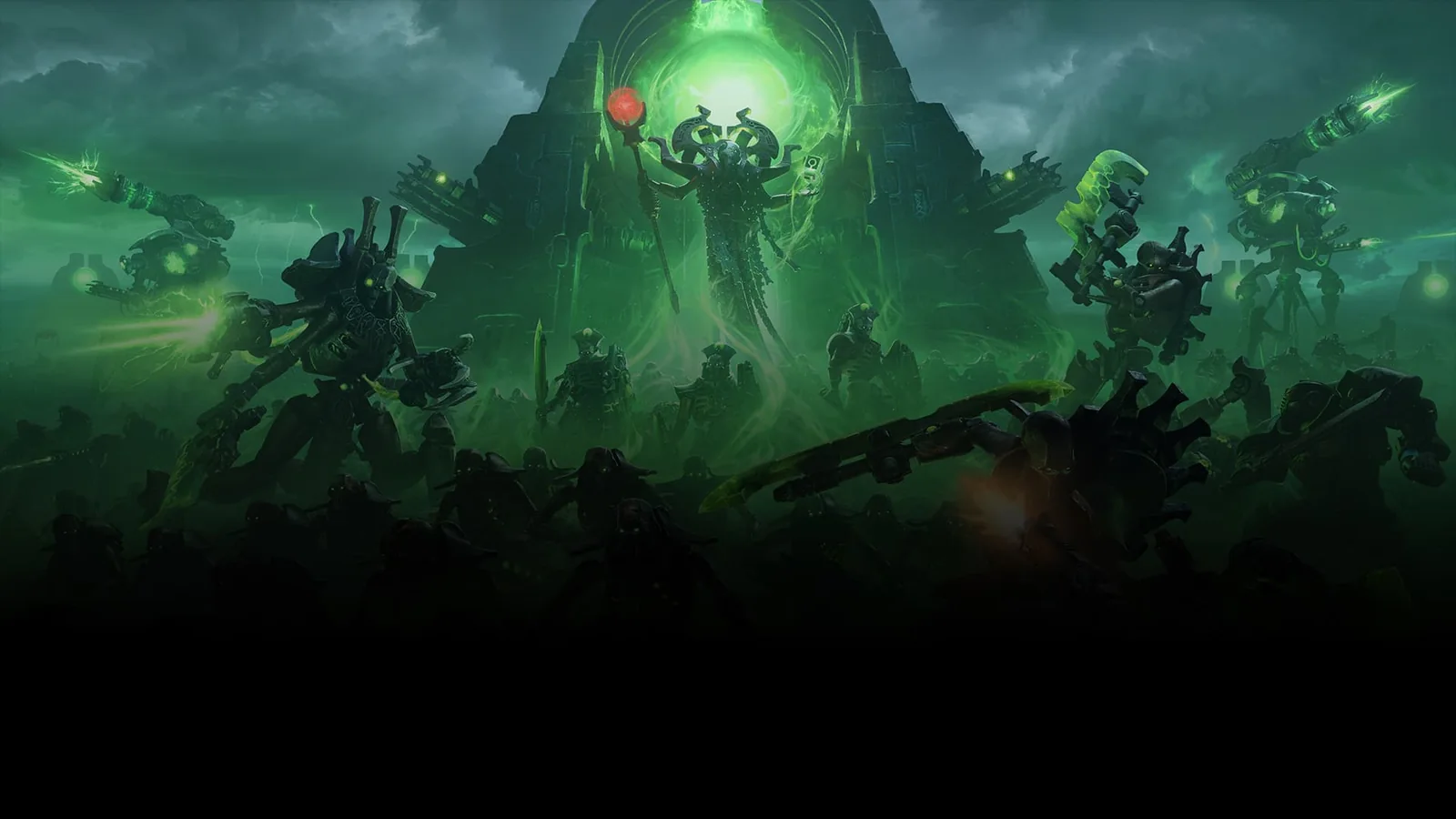
A playable faction whose slow, resilient expansion is designed to become a snowballing battlefield threat.
 ⤢ View full image
 Credit and source
Aucune INTERDICTION d'usage publiée. Constaté le 2026-08-17 puis le 2026-08-24, à deux adresses : https://www.deepsilver.com/games/dawn-of-war-iv/media et https://www.deepsilver.com/fr/about/imprint. Les deux ne portent qu'un avis de copyright — « © 2026 PLAION GmbH. All rights reserved. […] Developed by KING Art GmbH » — et aucune clause restreignant la reproduction, la distribution ou l'usage éditorial. Droits de l'univers : Games Workshop Limited 2026. Usage éditorial, crédité, retiré à la première demande de l’ayant droit (D-056, D-057, D-069).
Image source ↗Your reading, at a glance
Sourced facts
4 sourced factsRecord profile
- Documented playstyle
- Slow, steady expansion with high resilience and recovery
- Series history
- Not playable in the series since the Dark Crusade expansion
- Faction system
- Power Matrix
- Multiplayer identity
- Applies relentless pressure that can quickly escalate into overwhelming force
The role, in context
Necrons are a playable faction built around slow, steady expansion and exceptional resilience. Their upgradeable Tomb Citadel serves as both strategic centre and production engine, while structures spread the Power Matrix that supports construction, generates Dominion and strengthens friendly units within it. Resurrection Galleries recover a selected fallen unit type, and translocation systems offset the army’s slower movement. The qualified sources publish no complete roster, universal unit cost, faction-wide statistic or guaranteed performance level.
What is documented over time
The faction’s design deliberately balances durability and recovery against a slower overall pace. As the Power Matrix grows, economy, construction and friendly units become more difficult to separate from territorial expansion; the intent is a threat that gathers momentum rather than arriving fully formed. The story preview links that awakening to a mysterious signal from Kronus and the search for power hidden on the dormant tomb world. These are design and narrative foundations, not a balance log. No patch sequence, revised faction rule, version number or competitive history is published.
How it is presented in play
Published Necron guidance centres on methodical Power Matrix expansion and fighting within its influence, where friendly units receive additional benefits. Resurrection Galleries recover losses, while Tomb Pylons, Translocation Science and the Monolith provide different ways to move forces toward changing battlefronts. The strategic loop therefore connects territory, recovery and relocation. The sources do not supply a fixed build order, ideal Matrix shape, preferred Commander, universal unit mix or guaranteed recovery plan. High-level use can follow the documented systems without turning them into a solved competitive formula.
What you can — and cannot — conclude
The common error is to trade into Necron resilience on their own Power Matrix and allow slow expansion to gather momentum. The game page advises fighting them outside the Matrix, engaging their powerful ranged units, exploiting slow advances by striking vulnerable positions elsewhere, and focusing fire so units are finished rather than merely wounded. These are faction-level categories, not endorsements of named counter units. No universal build, damage type or exact target order is provided. Use the published pressure points without inventing a matchup or guaranteed way to stop recovery.